
Davis County Correctional Facility Releases
Davis County Correctional Facility is the secure adult county jail operated by the Davis County Sheriff's Office. Its population can include pretrial detainees, people serving county commitments, and people awaiting transfer. That mix makes “release” a result that must be read in context. Bail, a court-authorized release, or completion of a county commitment may return a person to the community. A transfer ends the Davis County jail episode but does not make the person free.
The destination field matters as much as the end time. Utah Department of Corrections, another county jail, the United States Marshals Service, or immigration authorities may receive someone directly. A detainer, which is a hold for another authority, can also change what follows the county case. The sheriff's booking and release record should identify the actual date, type or authority, and receiving agency when those fields are maintained and public. The court record explains the legal basis.
Confirm Davis County Correctional Releases
The Davis County inmate roster is the starting point for current custody, not the answer for a past release. Search the separate first, middle, and last name fields. Save the booking date and open the correct detail record. Its name number, exact booked time, arresting agency, charges, bond terms, and court clues can keep a later request tied to the right person and stay.
- Search the current roster and compare the name, age, booking date, and arresting agency before choosing a record.
- Save the name number, booked time, case clues, and roster time stamp while the entry is still visible.
- If the entry disappears, call corrections or submit a focused sheriff GRAMA request for the booking and release record.
- Ask for the actual end date and time, release authority or type, and transfer destination if maintained and public.
- Compare the answer with the court docket. Follow any transfer to UDC, another jail, USMS, BOP, or ICE.
The Davis County released inmate lookup expands that sequence across court, state corrections, supervision, VINE, and federal sources. A failed search in one system should never be treated as the disposition.
Davis County Correctional Release Records
Submit a county records request through the Davis County public records page or its NextRequest portal. A useful description names the person, a known name or booking number, and the approximate booking date. It asks for an existing booking, release, or jail-history record, not a new explanation prepared by staff.
| Requested field | What it answers |
|---|---|
| Booked name and aliases | Which identity was used for the episode |
| Name number or booking number | Which Davis County stay is at issue |
| Admission date and time | When county custody began |
| Actual release date and time | When the county episode ended |
| Release authority or type | Whether bail, court action, completion, or another basis applied |
| Receiving or transfer agency | Whether custody continued elsewhere |
GRAMA generally requires contact information and a reasonably specific description. The usual response deadline is as soon as reasonably possible and no later than ten business days. A qualifying public-benefit expedited request has a shorter period, and extraordinary circumstances may extend the deadline. Response time is not a promise of disclosure. Protected, private, sealed, safety-sensitive, or other restricted material may be withheld or redacted.
Note: Ask the records office to identify the maintaining entity, if known, when Davis County says it does not hold the requested record.
Davis County Correctional Records Contact
The correctional facility can route a custody or release question, while the county Records Manager handles the central GRAMA channel. Administrative office hours do not define jail operations or bail availability. Use the published number rather than a callback number supplied in an unexpected message.
Davis County Correctional Facility
800 West State Street
Farmington, UT 84025
Corrections: (801) 451-4200
Sheriff administration: (801) 451-4100
Administrative hours: Monday through Friday, 8 a.m. to 5 p.m.
Inmate mail: P.O. Box 130
Farmington, UT 84025-0130
The County Records Manager is at 61 South Main Street, Farmington, UT 84025, and can be reached at GRAMA@DavisCountyUtah.gov or (801) 451-3277. Court questions must go to the court that handled the actual case. Davis County Justice Court is not the right clerk for every booking, because felony and class A matters are heard in district court.
Davis County Jail Release Timing
The sheriff FAQ says last-day commitment releases typically begin at 8 a.m. The sheriff's more detailed inmate-information page says people finishing commitments are generally released near the hour when they were booked. These statements describe workflow from different angles. Neither is a fixed promise for one person.
Eligible bail may be posted at any hour. Processing can still take several hours based on jail workload, receipt of authority, and other holds. A judge's order, a listed bond amount, or a payment does not by itself prove that physical release is complete. Davis County also withholds exact individual release dates and times from the public web for safety. Confirm the actual event afterward through the retained record.
The official facility information capture documents the sheriff's release, bail, property, and mail instructions.
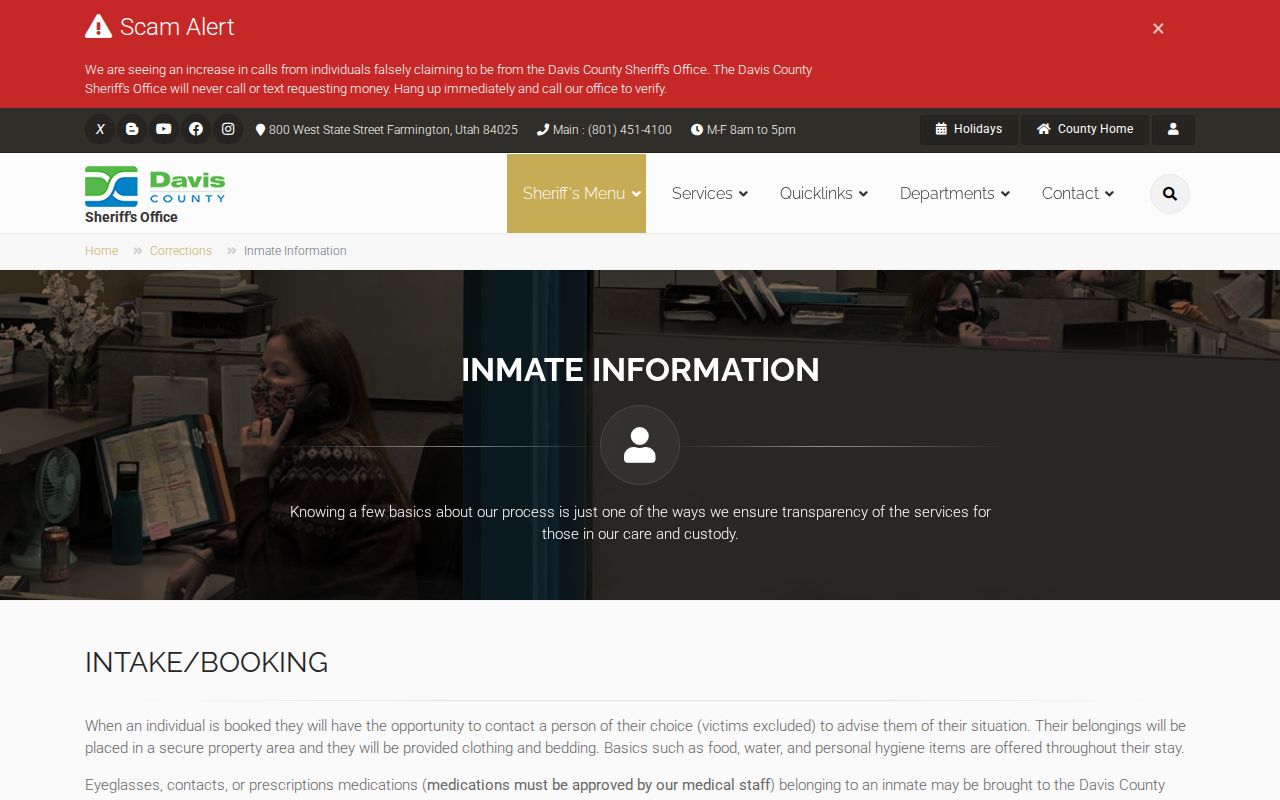
The image supports the process limits. It does not provide a personal release date or create a list of people who have left custody.
Davis County Roster Release Limits
The current roster's detail modal says information refreshes every 15 minutes. That cadence applies to the current-care-and-custody display. It is not a 15-minute release feed, and pagination does not reveal older jail episodes. The page also describes itself as informational rather than an official record or legal document.
A match means the sheriff currently lists the person. A missing name can result from release, transfer, spelling differences, a merged or corrected record, or processing lag. Save the roster time stamp and the last known identifiers. Then obtain the actual disposition. The charge-level “disposition” field inside a detail record should not be assumed to be the later custody-release type.
| Roster result | Supported meaning | Next check |
|---|---|---|
| Matching current row | Current listed Davis County custody | Open details and save identifiers |
| No matching row | No conclusion about release or transfer | Sheriff record and court case |
| Recent booking date | Recent intake for someone still listed | Do not relabel it as release |
| UDC result after removal | Possible state custody or supervision | Read UDC status and Board order |
Davis County Transfers After Release
A transfer is not a community release. If the sheriff record identifies UDC, use the UDC Offender Search for a person currently incarcerated, on probation, or on parole. It does not cover an unsentenced Davis County detainee and is not a full archive after state supervision ends. A Board order can explain a parole date, while UDC confirms the state status after that date.
Davis County has an agreement to house some federal prisoners and material witnesses for USMS. A federal defendant may vanish from the county roster because USMS moved the person. USMS has no general public historical locator. Check the holding authority and federal court record, then use the Bureau of Prisons locator only after BOP designation or custody. A BOP release date proves the end of BOP custody, not the earlier Davis County event.
ICE is another limited route. Its locator covers current immigration detention and a limited recent period, not county release history. A Davis County record showing transfer to ICE means county custody ended while detention may have continued. No ICE detention center was identified within Davis County, and the Ogden check-in office serving the area is not a detention facility.
Note: Follow the receiving agency named by Davis County rather than searching every custody system without a jurisdictional reason.
Davis County Release Photos and Property
The Davis roster shows a generic placeholder, not a web booking photograph. A photo must be requested as a separate record. Utah Code § 17-72-802 requires a requester statement and restricts certain publication uses, while GRAMA classification may still protect the image. A UDC prison photo is a separate state record and should not be described as the county booking photo.
Property and mail follow their own clocks. During custody, a property authorization must reach the sheriff by Friday at 5 p.m. for the following Monday pickup period from 10 a.m. to 3 p.m.; the recipient needs government photo identification, and keys are considered case by case. After transfer, unclaimed property is disposed after 30 days. Mail is usually returned to sender after release, with a limited pickup period in the situations the sheriff describes.
These tasks do not prove release status. A property pickup can occur under authorization while a person remains in custody, and mail handling may continue after an exit. Use the custody record for the release and the sheriff's property process for belongings.
Verify Davis County Early Release Claims
The Davis County sheriff warns about callers who claim a loved one qualifies for early release through an “Ankle Monitor Program” if family pays a large sum, sometimes in Bitcoin. Davis County does operate court-ordered ankle monitoring. That real program does not make an unsolicited payment demand legitimate, and the sheriff says it does not demand direct family payment or Bitcoin.
End the call and contact the published sheriff number. Do not use a caller's transfer number, payment link, or wallet address. Confirm any court-ordered release condition through the actual court and the Davis County record. The Davis County Work Release Center has a separate role in community corrections; its existence does not verify a caller's claim or prove that someone has been discharged.
A person on ankle monitoring may remain subject to court terms. Pretrial Services, probation, parole, and work-release programs also serve different legal stages. Physical release from the secure building and final discharge from a case or sentence are not the same event.