
Understanding Davis County Releases
Released means one custody episode ended. It does not always mean a person walked free. At the Davis County Correctional Facility, bail, a court order, or completion of a county commitment may return someone to the community. A transfer to another jail, the Utah Department of Corrections, the U.S. Marshals Service, or immigration custody ends the Davis County episode while custody continues. The sheriff's record is therefore more useful than a roster disappearance alone.
Several terms matter. Bail is a conditional pretrial release. Time served means a court credited enough custody to complete the jail term. Probation is court-ordered community supervision. Parole is a Utah Board of Pardons and Parole release from a state-prison sentence to UDC supervision. Discharge ends a sentence or supervision. A detainer is another authority's request to hold or receive a person. Each result sends the search to a different agency.
- Community release
- The person leaves custody, subject to any court or supervision terms.
- Transfer
- Davis County custody ends, but another authority takes custody.
- Expungement
- A legal process that restricts ordinary public access to qualifying records.
- Remand
- A court order sending a person into custody or back into custody.
Davis County Inmate Release Types
The release category determines what should appear next. A court case can explain the authority, but the Davis County booking and release record documents how the jail acted on it. A transfer must not be labeled as freedom. Likewise, dismissal or acquittal describes a case result, while the jail still has its own physical exit event.
| Release type | Meaning | Next source |
|---|---|---|
| Bail or court order | Conditional release while a case is pending | Sheriff record and court docket |
| Commitment complete | The county custodial term ended | Sheriff release record |
| Probation | Court supervision in the community | Court order and UDC AP&P |
| Parole | Board-authorized release from state prison | Board order and UDC status |
| Transfer or hold | Custody moved to another authority | Named receiving agency |
| Discharge | Sentence or supervision ended | Final court, Board, or UDC record |
A work-release participant may be outside the secure building for an approved activity and still remain in custody. Movement from the Davis County Work Release Center back to the secure jail is also a reassignment, not a release. Juvenile departures from Farmington Bay Youth Center follow juvenile court, JJYS, and Youth Parole Authority rules, not the adult roster.
Note: A Davis County custody transfer closes one jail episode but does not prove the person entered the community.
Davis County Release Record Fields
A focused record connects identity, one booking episode, the authority for leaving, and the destination. Davis County decides which fields exist and which are public, so these are fields to request rather than a promise of disclosure. Include a known name number, booking number, arresting agency, booking date, or case number whenever possible. Those details reduce the risk of mixing people with similar names.
| Field to request | What it shows |
|---|---|
| Full booked name and aliases | The identity used for that custody episode |
| Name or booking number | The sheriff's link to the correct booking |
| Admission date and time | When Davis County custody began |
| Actual release date and time | When that county custody episode ended |
| Release type and authority | Bail, court order, completion, transfer, or other disposition |
| Case or court number | The legal matter tied to the event |
| Receiving agency | Whether another authority continued custody |
| Booking photograph | A separate record subject to Utah's sheriff photo law |
Request Davis County Release Records
The official fallback is a narrow GRAMA request through the Davis County public records page or the county's NextRequest portal. Ask for an existing booking, release, or jail-history record. Do not ask the records officer to research a story or create a new report. State a date range, identify the booking episode, list the specific release fields, and permit redaction of unrelated restricted material.
- Gather the full booked name, name number or booking number, booking date, arresting agency, and case number.
- Address the request to Davis County and identify the sheriff booking or release record with reasonable detail.
- Ask for admission and actual release times, release type or authority, and any named transfer destination if maintained and public.
- Submit contact information and any identification required for the sheriff report process.
- Review the response, any redactions, the stated legal classification, and appeal information if access is denied.
Davis County Records Manager
61 South Main Street
Farmington, UT 84025
GRAMA@DavisCountyUtah.gov
(801) 451-3277
The sheriff lists a $10 police-report processing charge and $0.25 per page for other documents, with estimates for large requests and cash payment for sheriff records. Those published amounts are not a guaranteed release-record fee. Utah Code permits reasonable actual costs, and the responding office should quote the charge. The usual GRAMA response deadline is no later than ten business days, with a five-business-day route for a qualifying public-benefit request and possible extensions for extraordinary circumstances.
See the official request page before sending a request. The captured portal view below helps identify the county submission route, and the response itself determines which Davis County release fields can be produced.
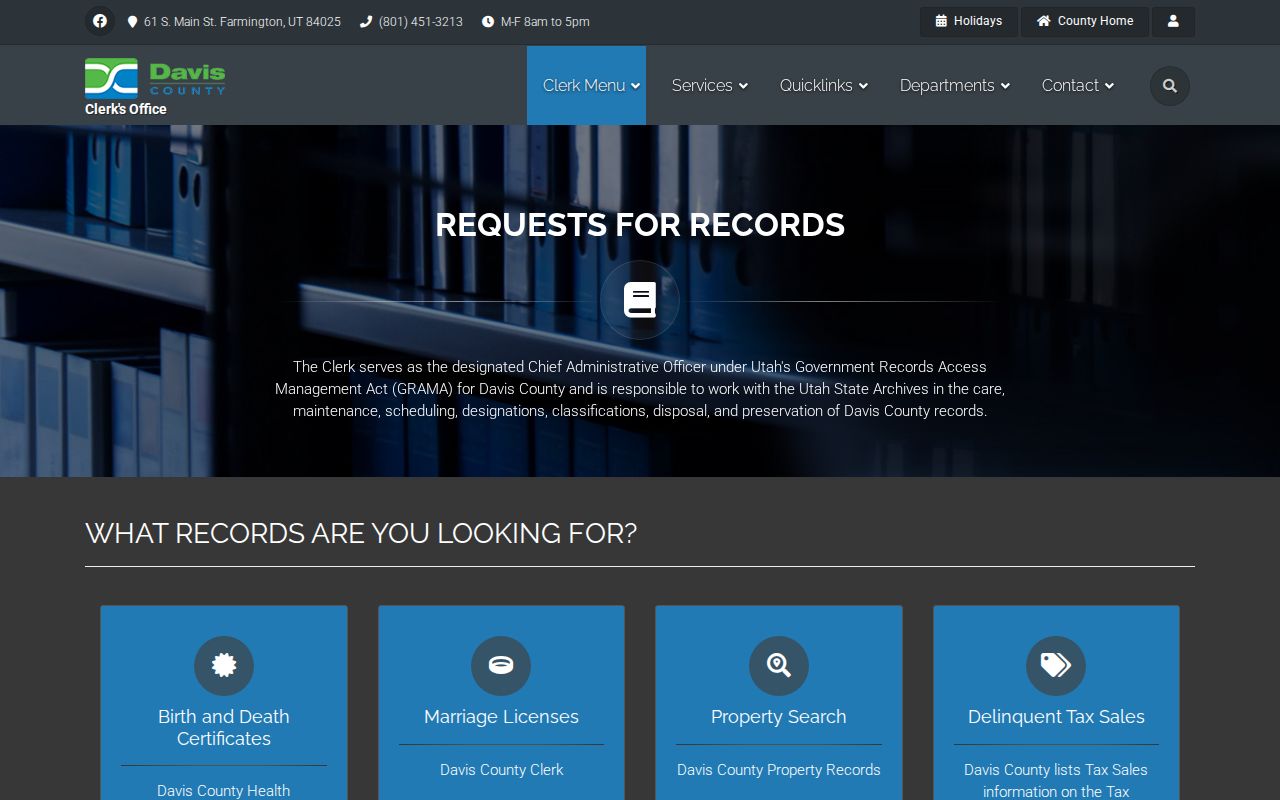
The county portal is the strongest historical path when a released person no longer appears on the live sheriff roster.
Note: Ask for the booking photograph separately because Davis County routes that record through a distinct Utah statutory process.
Utah Law on Davis Releases
Utah's Government Records Access and Management Act, known as GRAMA, classifies government records and sets the request process. Utah Code § 63G-2-204 governs request content and agency response. Section 63G-2-203 addresses reasonable fees and possible waivers. Sections 63G-2-205 and 63G-2-401 cover denials and administrative appeals. Public access does not erase limits for juvenile, sealed, private, protected, medical, victim, or safety-sensitive material.
Retention is not the same as online display. Davis County publishes no historical released-person roster or online retention period. The sheriff may retain a custody record after the live entry disappears. Courts can retain the related legal record under their own access rules. An expunged case is removed from public Xchange, and MyCase may show a generic expunged notation to the subject. Expungement restricts ordinary access; it does not prove that no custody event occurred. Current Utah Courts guidance controls because state expungement law changed in 2026.
Note: The office that keeps the record controls access, classification, redaction, fees, and the form of its response.
When Davis County Releases Begin
Davis County does not publish an exact release time for a named person. The sheriff's FAQ says commitment releases typically begin at 8 a.m. on the last day, while the inmate-information page places completion near the original booking hour. Bail-eligible people may be bailed out at any hour, though processing can take several hours when the jail is busy. Court releases move as staff receive and process valid authority.
These facts explain workflow, not a promise. Another case, warrant, detainer, transfer order, identity check, or administrative step may delay physical exit. The jail record is still required to establish the actual time. For a state prisoner, a Board date is also not enough on its own because the order can change before release and UDC controls the physical process.
Travel After Davis County Release
The sheriff confirms that public transportation is nearby, but it does not publish a release door, family waiting area, fixed route, or jail shuttle. UTA identifies Farmington FrontRunner Station at 450 North 850 West. A person arranging a ride should use current UTA trip information because routes and service times can change. No one should infer that the station is the point where the jail releases people.
Release-day travel depends on the actual destination. A community release may require a local ride, while transfer to UDC, another county, USMS, or ICE means the receiving authority controls movement. Family members should verify the custody outcome first. That prevents a trip to Farmington when the person has not left custody at all.
Note: Davis County confirms nearby transit but does not promise a route, shuttle, release entrance, or family waiting area.
Davis County Pretrial Release
Davis County Pretrial Services at 28 East State Street helps eligible defendants leave jail while a criminal case remains pending. It can monitor court-ordered conditions, reminders, and compliance. This is not probation, parole, or final discharge. The court still controls the case, and the sheriff's release record identifies when the county jail acted on the order.
A bail amount on the roster also shows possible terms, not proof of payment or release. When a pretrial defendant disappears from the Davis roster, compare the jail record with the court's bail or release order. If Pretrial Services is involved, its role explains community monitoring but does not replace the custody record.
Davis County Release Counts
Davis County reported 8,242 bookings and 6,241 releases for 2022. Its 2024 tentative budget also listed 6,597 bookings and 5,122 releases for 2023, but those figures were explicitly year to date. They must not be presented as full-year totals. The numbers show the scale of county corrections work, not a list of names or a way to find one person.
Bookings and releases should not be divided to invent an average stay. Reporting periods and program categories differ, people can have more than one episode, and transfers can close county custody without a community release. Each period also begins and ends with people already in custody.
Find Davis County Released Inmates
Start with jurisdiction, then seek three kinds of proof. The custody record establishes the physical event. A court or Board order explains the authority. A receiving or supervising system shows what happened next. The search should change when the facts point from county jail to state prison, probation, parole, federal custody, immigration custody, or juvenile care.
- Search the Davis County current roster by first and last name. Save booking and name identifiers from a matching detail record.
- If the name is gone, request the sheriff's release or transfer disposition for that booking episode.
- Read the correct court case through Xchange or a courthouse terminal for the order, judgment, dismissal, sentence, or warrant action.
- Check UDC and the Board only when state imprisonment, probation, or parole applies.
- Use Utah VINE for a selected-person notification, then confirm the event with the contributing agency.
- Use BOP, ICE, or the receiving authority only when federal or immigration facts support that path.
The official sheriff roster view documents what this first step can and cannot do. It lists current care and custody, accepts separate name fields, and displays booking information rather than a release archive.
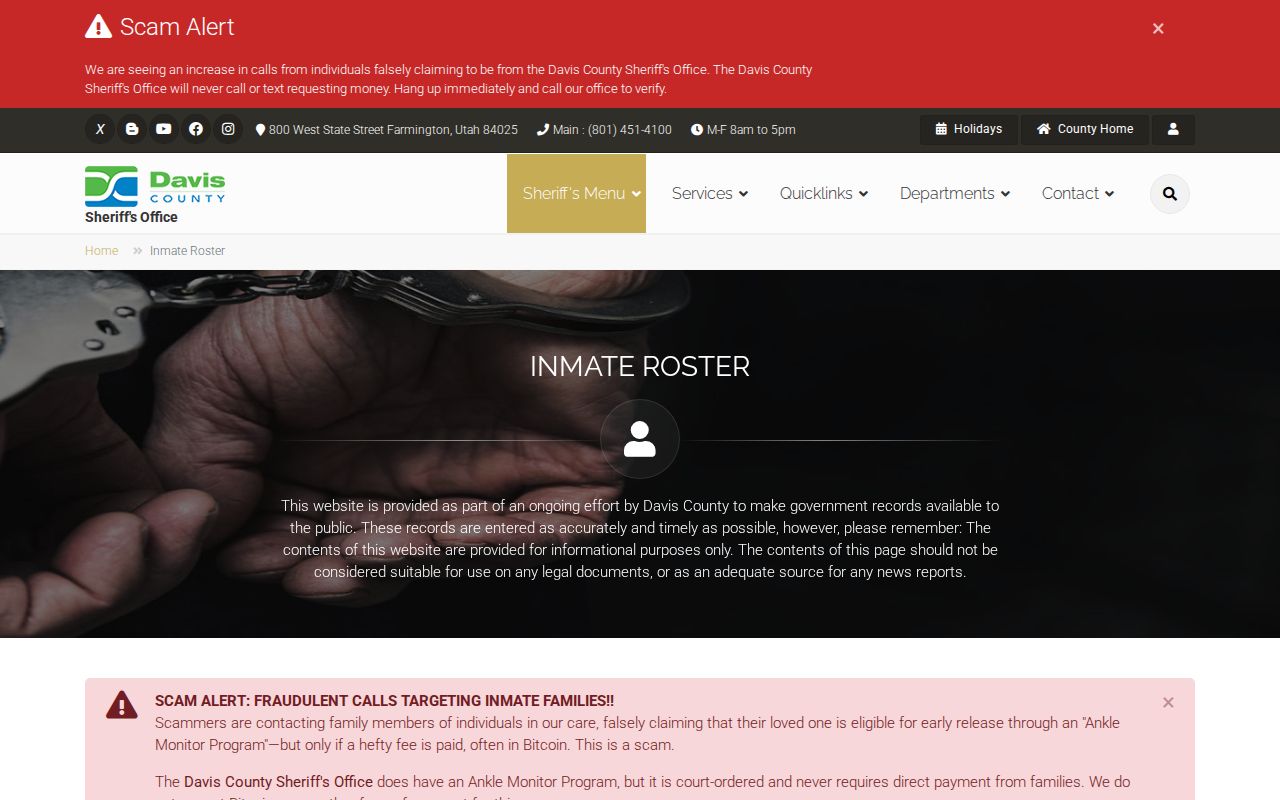
A missing result requires the next step. Davis County publishes no official 24-hour or 72-hour release feed, so the Released Last 24 Hours process leads with a date-specific record request rather than an invented list.
UDC Search After Davis Release
The Utah Department of Corrections Offender Search covers people currently under UDC supervision. That includes incarceration, probation, and parole. It excludes an unsentenced person held only in a county jail, and it is not a full archive of everyone who has completed all UDC supervision. A Davis County roster disappearance followed by a UDC result may indicate transfer or current community supervision, not unconditional discharge.
| Search field | Use | Limit |
|---|---|---|
| UDC number | Best match when the identifier is known | Applies to UDC records, not a county booking number |
| First name | At least one character is required for name search | Aliases and spelling differences may divide results |
| Last name | At least one character is required for name search | Compare identity details before selecting a record |
| Status and location | Read from the returned detail record | Only live fields shown by UDC should be reported |
| Parole/release date | Compare a displayed date with the Board order | A future date is not proof of physical release |
Use the UDC number when known. Otherwise enter the most complete name, compare identity details, and open the correct record. The verified agency wording is “Parole/Release date,” not a promised “projected” field. Utah has no general 85-percent rule for ordinary state prisoners. For a fully discharged person who no longer appears, use the Board decision search and request the retained UDC record.
The official UDC search page states its current-supervision scope. The captured screen reinforces why this tool cannot replace a Davis County jail release record.
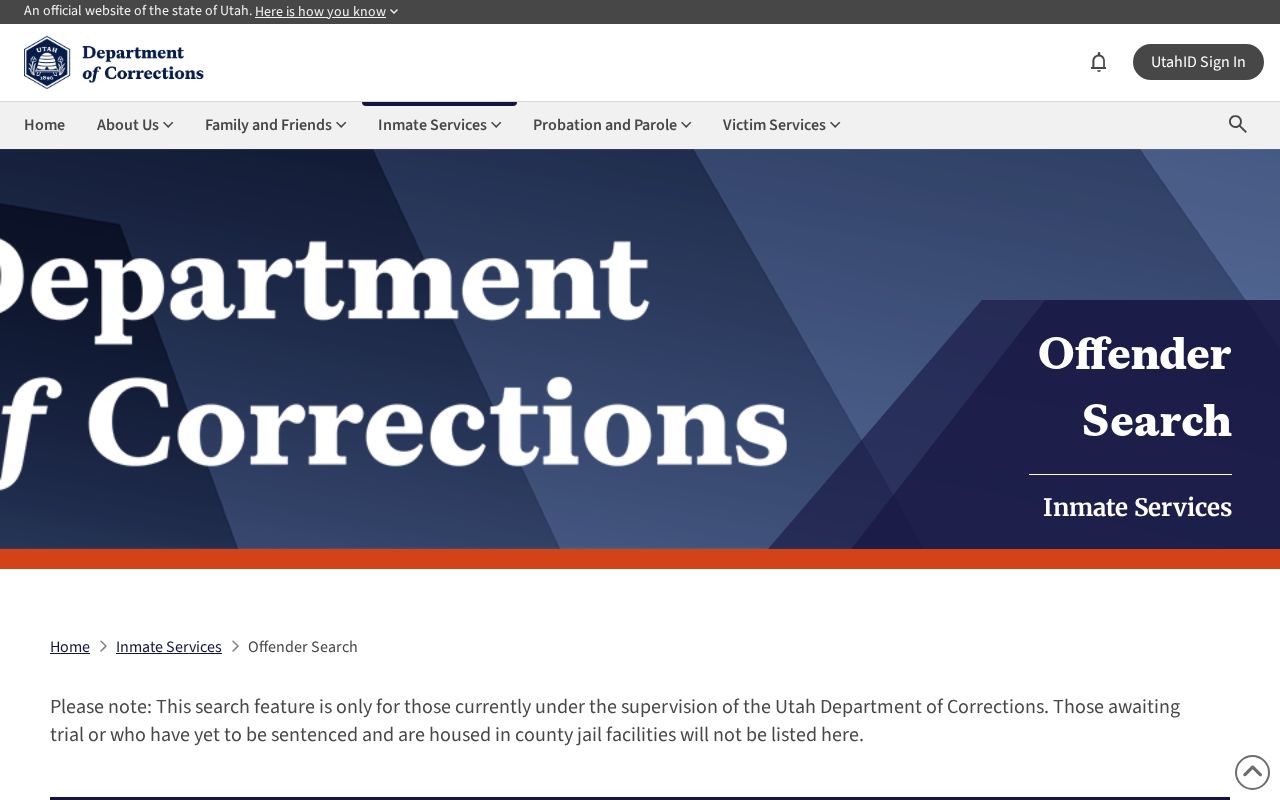
Read the scope warning before interpreting a no-result response, especially when the person may have completed supervision.
Court Records and Davis Releases
Utah Courts Xchange provides public district and justice court case information, subject to access rules. Search the court tied to the case, not merely the jail's location. A docket can show a bail order, dismissal, judgment, sentence, time-served credit, warrant recall, amended order, or probation term. Those entries explain legal authority. They may not show the exact time the jail completed release processing.
MyCase is free but limited to a party and, under current access, a victim in a linked criminal matter. It is not a public name search. Public users rely on Xchange, courthouse terminals, or the State Law Library. Sealed, expunged, private, and juvenile matters are excluded from ordinary public Xchange access. Always pair the court result with the sheriff's physical release or transfer record.
Note: A case closure or dismissal may explain authority, but neither entry by itself establishes the jail's physical exit time.
Davis Release Supervision Checks
Probation and parole both permit a person to live in the community under conditions, but they arise from different authority. A court orders probation. The Utah Board of Pardons and Parole grants parole from a state-prison sentence, and UDC Adult Probation and Parole supervises it. Pretrial Services monitors some pending-case defendants and is separate from both.
Search UDC for current probation or parole, then compare a parole result with the Board's hearing and decision search. The Region 2 Farmington AP&P office can route questions at (801) 451-4700, while the Board support line verifies Board status at (801) 261-6464. A person who fully terminated supervision may leave UDC's public search because its stated scope is current supervision. More detail appears on the Parole / Probation page.
Note: No official statewide public list of AP&P absconders was verified, so a missing search result cannot support that label.
Davis County Release Reentry Help
The Davis Community Reentry Coalition advertises a Thursday resource fair from 11 a.m. to 1 p.m. at 380 South 200 West in Farmington. Listed support includes peer help, behavioral-health care, Medicaid information, and other community services. The coalition notes that it is under new leadership, so its current page should be checked before travel.
Reentry support is not proof of release, parole, or probation. It begins after the custody question has been resolved and may help a person reconnect with local services. Agency roles remain distinct even though many Davis County corrections, court, pretrial, and supervision offices are clustered in Farmington.
Property After Davis County Release
Property and mail follow their own deadlines. For in-custody property pickup, the sheriff requires an authorization form by Friday before 5 p.m. for pickup the following Monday from 10 a.m. to 3 p.m. The recipient needs government photo identification, and keys are handled case by case. This process applies before release and should not be confused with collecting belongings after custody ends.
After a transfer, certain unclaimed property may be disposed of after 30 days. Mail is normally returned to sender when the person leaves. If it cannot be returned, or if it is being returned to the released person, Davis County allows pickup for 30 days before destruction. Prompt contact with the corrections office helps avoid loss.
Davis Release Alerts and Transfers
Utah VINE can search a specific participating record and register phone or email notices. Select Utah, enter the exact name or offender number, compare the agency and identity details, and open the matching record. A notice can corroborate a custody event, but it is not a certified release record and may lag. Davis County participation was not independently documented in a complete public agency list, so a failed search must return to the sheriff.
Federal and immigration sources apply only when the facts support them. The BOP Inmate Locator can show federal records from 1982 onward, including a past federal release date and a no-longer-in-BOP-custody result. Davis County has housed USMS detainees, and a roster disappearance may mean transfer to federal control. ICE's locator covers current detention and a limited recent period after ICE release. None of these tools proves a county jail release by itself.
Match Davis Releases to Records
The right system depends on both the custody type and the time period. The sheriff roster answers a present county-jail question. A county release record answers a past county episode. UDC and the Board address state imprisonment or current supervision. Court records explain legal authority, while BOP and ICE apply to separate federal systems.
Still in Davis County custody: use the current sheriff roster and corrections office.
Released or transferred from Davis County: request the sheriff booking and release record, then check the court or named receiver.
In state prison, parole, or probation: use UDC and, for parole decisions, the Utah Board.
Federal or immigration custody: use BOP, ICE, the federal court, or the actual receiving authority.
Can one source prove everything? No. A court order can authorize release without stating the door-out time. A jail record can prove the physical event without resolving later supervision. A receiving-agency record completes the path when custody continued elsewhere.
Davis County Release Facilities
Three facilities belong in the Davis County release map. They serve different populations and cannot share one lookup method. The primary jail handles adult county custody. The Work Release Center serves a county community-corrections function. Farmington Bay Youth Center operates within Utah's confidential juvenile system.
- Davis County Correctional Facility: community release may follow bail, court action, or commitment completion; transfers remain custody.
- Davis County Work Release Center: confirm program completion through sheriff records and the sentencing court; return to secure jail is not release.
- Farmington Bay Youth Center: use JJYS, juvenile court, parent or guardian channels, or Youth Parole Authority as legally permitted.
The adult roster must never be used to verify a youth's departure. Likewise, no UDC prison, federal prison, or ICE detention center was identified within Davis County. Those agencies are access channels when a Davis case leads elsewhere, not local facilities that should be added to the county list.